

In the field of cosmetic packaging, Airless Bottles/Pumps have become the preferred packaging for high-end serums, creams, sunscreens, and efficacy-focused products due to their exceptional preservation, protection of high-active ingredients, residue-free dispensing, precise dosing, and premium texture. This article systematically analyzes their material properties, molding processes, technical principles, key quality control points, and cost structure.
1. Main Materials for Airless Bottles
An airless bottle is a multi-component system, with different parts made from various materials:
| Component | Common Materials | Characteristics & Function |
| Bottle Body | AS | High transparency, good hardness, relatively good chemical resistance (prevents content permeation) |
| ABS | Higher toughness, impact resistance, but lower transparency than AS | |
| PP | Semi-transparent to opaque, excellent chemical resistance, low cost, often used for mid-range products | |
| Glass | Ultra-premium texture + barrier properties; inner wall requires SiO₂ coating for permeation prevention; high cost | |
| Piston / Inner Liner | HDPE | Good flexibility, compression resistance, forms a sealed, airtight layer |
| PP | Higher rigidity, used for structures requiring stronger support | |
| Pump System | PP | Fatigue resistance, high chemical stability |
| POM | High hardness, low friction coefficient, ensures smooth valve operation | |
| Silicone / EPDM | Long-lasting elasticity, aging resistance, ensures airtightness | |
| Dip Tube | LDPE | Flexible and easy to bend; bottom weight ball (PP/Stainless Steel) ensures complete product evacuation |
| Outer Cap | ABS / PP | Decorative and protective; can be plated or sprayed to enhance texture |
2. Classification of Airless Bottles
1. By Working Principle
| Type | Principle | Advantages | Limitations |
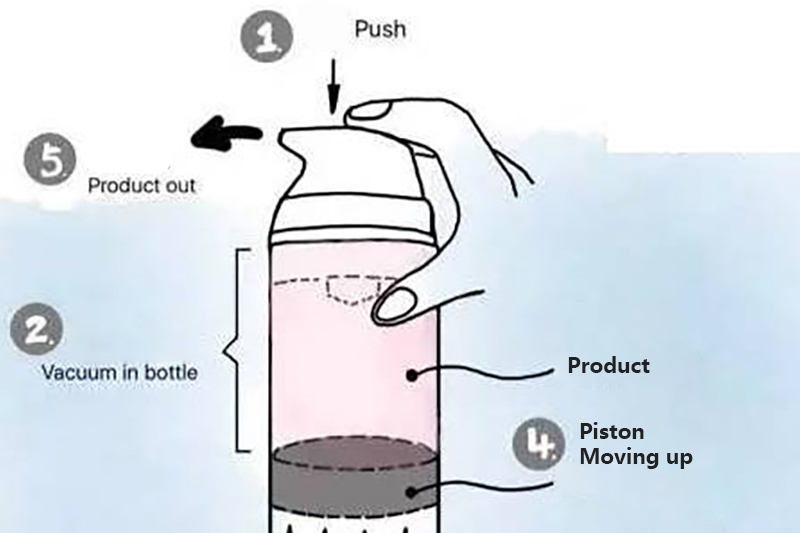
| Piston-type (Mainstream) | Bottom piston moves upward upon pressing -> Creates negative pressure inside bottle -> Contents rise | Reliable structure, good seal, residue rate <5% | Extremely high piston precision required |
| Bag-type | Flexible inner bag contracts -> Contents expelled, outer bottle doesn’t deform | Completely isolates air, ultra-high preservation | Very high cost, low production capacity |
2. By Bottle Body Material
·All-Plastic Airless Bottle (AS/ABS body + PP inner liner, occupies 80% of the market)
·Glass Airless Bottle (Glass body + plastic inner liner, exclusive to high-end lines)
·Metal Airless Bottle (Stainless steel shell, niche luxury)
3. By Pump Head Type
| Type | Characteristics | Suitable Products |
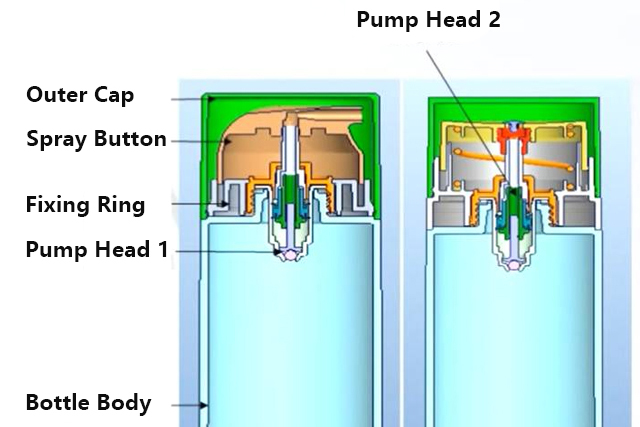
| Round Head Pump | Basic press-down type, output 0.1ml-0.5ml | Serums, Eye Care Products |
| Flat Head Pump | Wide mouth output, output 0.3ml-1.5ml | Creams, Sunscreen |
| Spray Pump | Atomizing nozzle, particle size 50-100μm | Spray Serums, Setting Sprays |
| Tube-less Pump | Direct contact with paste, suitable for high-viscosity products | Foundation Sticks, Concealers |
3. Airless Bottle Manufacturing and Technical Principles
Core Process Flowchart
A[Bottle Injection Molding] -> B[Inner Liner/Piston Assembly]
C[Pump Head Injection Molding] -> D[Valve Spring Assembly]
B + D -> E[Final Assembly]
E -> F[Filling & Sealing]
F -> G[Negative Pressure Seal Test]
Detailed Technical Principles
1. Vacuum Formation Mechanism:
·First Press: Drives the piston upward -> Air inside the bottle is expelled through the exhaust valve -> Creates a negative pressure zone.
·Release Press: Spring resets -> Creates negative pressure at the bottom of the dip tube -> Contents are drawn into the pump chamber.
·Subsequent Press: Product in the pump chamber is expelled, while the piston synchronously moves up to fill the space -> Zero air contact.
2. The “Residue-Free” Secret:
·Gap between piston and bottle body ≤ 0.05mm, ensuring product cannot flow back.
·The weight ball at the bottom of the dip tube descends with the product level, always maintaining contact with the product.
4. Key Quality Control Points for Airless Bottles
| Failure Mode | Test Method | Acceptance Standard |
| Vacuum Failure | Helium Mass Spectrometry Leak Test | ≤1×10⁻⁸ mbar·L/s |
| Piston Sticking | 50 Consecutive Presses – Resistance Test | Resistance fluctuation ≤ 15% |
| Product Contamination | GC-MS Migration Test | Non-volatile residue ≤ 50 μg/g |
| Pump Head Dripping | Inverted 24-hour Observation | Drips ≤ 1 |
| Life Cycle Test | Simulated 3000 Presses | Output Deviation ≤ ±10% |
5. Procurement Decision Guide
6 Factors for Supplier Selection
1. Patent Technology:
·Piston coating technology (e.g., PTFE coating to reduce friction).
·Spring-less pump head design (solves metal spring corrosion issues).
- Production Capacity Assurance:
·Piston precision requirement ±0.01mm (requires slow wire-cutting machines).
3. Compliance Certifications:
·FDA 21 CFR §177.1640 (for AS material).
·EU 10/2011 (Food contact grade silicone).
4. Replaceable Design:
·Replaceable inner liner (reduces environmental cost).
·PCR plastic application (Post-Consumer Recycled material ≥ 30%).
5. Refill Compatibility:
·Whether it supports consumer self-replacement of inner liners (trend for high-end brands).
6. Emergency Response:
·Provide solutions within 48 hours in case of piston batch abnormalities
Application Scenarios and Innovative Advantages
High Value-Added Product Adaptation
| Product Type | Airless Bottle Solution | Value Addition Point |
| Vitamin C Serums | Brown glass body + Fully sealed pump head | Blocks UV/Oxygen, preserves activity |
| Anti-Aging Creams | Ceramic texture coating + Magnetic cap | Enhances luxury feel, avoids product contamination |
| Sunscreen Lotions | Airless spray pump (SPF value stability ±5%) | Prevents UV filter degradation |
| Single-Dose Serums | Replaceable inner liner (1 outer shell + 12 liners) | Reduces plastic waste by 70% |
Forward-Looking Technology Directions
·Smart Airless Bottles: Built-in RFID chip records opening time, connects to phone for expiry reminder.
·Self-Sterilizing Pump Heads: Silver ion coating inhibits microbial growth.
·Carbon Neutral Packaging: Bio-based AS (from sugarcane ethanol) + Carbon footprint certification.
Summary:
Golden Rules for Airless Bottle Procurement
- Active ingredient content > 15% necessitates airless packaging -> Prevents inactivation rate exceeding 30%.
2. Prioritize suppliers with piston coating technology -> Reduces friction coefficient by 50%.
3. Initial order must undergo 3-month accelerated testing -> Mitigates risk of silicone swelling.
4. Require migration test reports -> Regulatory red lines cannot be crossed.
Allocate 20% of the cost for surface finishing -> Premium feel can achieve up to 300% price premium.
Airless bottles have evolved from purely functional packaging into a core carrier of brand technological appeal and sustainability concepts. Future competition will focus on three key dimensions: material innovation (degradable inner liners), smart interaction (usage monitoring), and low-carbon manufacturing (solar-powered production).